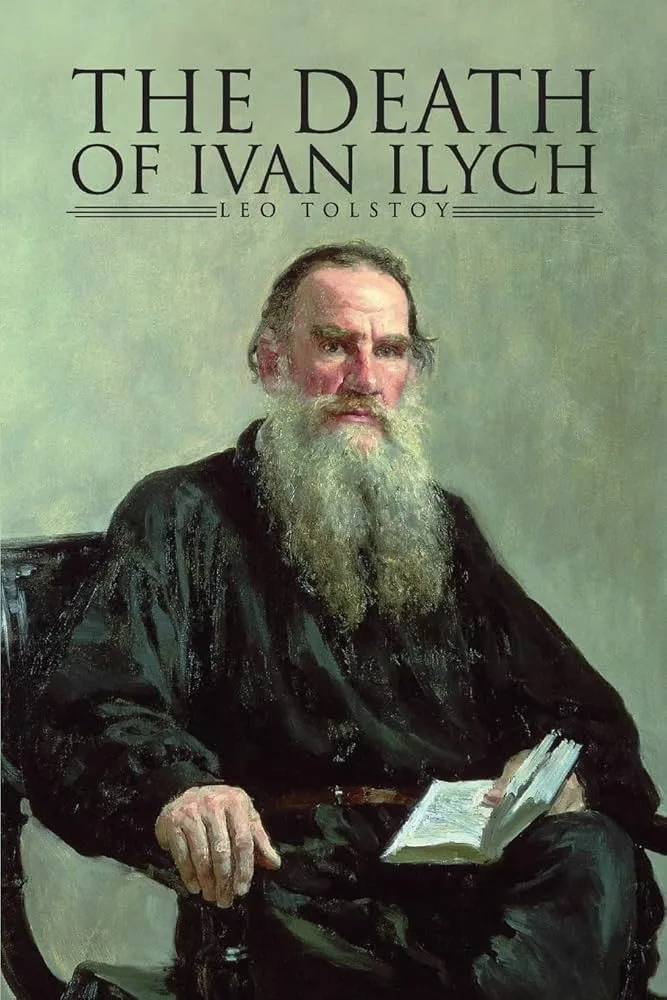
Perhaps it is best to begin in the same way Tolstoy structured this novel—starting with the end. Or more precisely, what happens after the end.
A man named Ivan Ilyich, father of two children; a beautiful young daughter with a noble suitor and a younger son still in school. His wife, Praskovya Fyodorovna, is by his side. Ivan Ilyich was an independent man who completed law school with top marks, entered into society, and built what appeared to be an exemplary life.
The novel opens at his funeral and then takes us back to review his life from childhood to death. A bitter tale of life's decline and the unstoppable passage of time. Tolstoy swiftly moves through Ivan's youth, pausing only briefly before plunging into the central theme—his final years, and more importantly his final weeks in which he confronts death itself.
The story goes on with telling how Ivan constantly tries to adopt the common public idea of a decent and good life, so he studies hard in school then he tries to be excellent at his different job positions, he makes many connections with high-rank people, and even at his job he tries not to be strict so he always tries to separate his life from his job, that is why many of his friends like him and consequently he reaches the highest statues in his work life.
He always tries to support his family and prepare everything for them, and he does. But rather than achieving fulfilment through these societal ideals of promotion and family, something shifts when he marries his wife. Very soon all the joyous in his married life fades.
"His wife become more and more petulant and irascible but the attitude Ivan Ilyich had adopted toward domestic life made him almost impervious to her carping… although his salary was higher, the cost of living was greater, moreover, two of their children had died, and so family life became even more unpleasant for Ivan Ilyich. Praskovya blamed her husband for every setback they encountered."
Despite this, Ivan keeps moving forward. He maintains his outward image and works tirelessly, choosing work over family life to avoid confronting the emptiness within.
The Accident That Changes Everything
Everything is working out until one day he feels a slight pain on the left side of his stomach, he had an accident while preparing the house for the family but he ignores it. As time goes by, the same house becomes a prison for him, the same house which Ivan had painted and prepared for more than several months, he was very excited that the family could come and see his work. So from a simple accident, a small pain in the side of his body Ivan Ilyich's life starts to change completely.
The following weeks and months of his life are stunning—how he starts to question everything. To look back at his life, to review all his relations with everyone even with himself, and more than that with life and God itself, he starts to unravel.
The main focus of the novel is Ivan's gradual realization of the emptiness of his achievements. At first, he believes he has lived the best possible life, but as he revisits his past, this belief crumbles, until he ultimately admits that his entire existence has been meaningless.
"What had induced his moral agony was that during the night, as he gazed at Gerasim's bread-boned, sleepy, good-natured face, he suddenly asked himself: 'What if my entire life, my entire conscious life, simply was not the real thing?'"
The Weight of Loneliness
As we move forward in the story, the pace of narration slows, mirroring the creeping weight of death itself. Ivan Ilyich realizes that life was always leading him toward loneliness and that his death would mean nothing to anyone.
"He cried about his helplessness, about his terrible loneliness, about the cruelty of people, about the cruelty of God, about the absence of God."
As the novel progresses, the pace slows, mimicking the way death gradually overtakes life. It is as though death, though inevitable, forces one to sink deeper into its quicksand, making each step feel heavier. The final dialogues of Ivan Ilyich are striking, drawing the reader into his desperate contemplation. He constantly questions:
"What sin has he committed to deserve this?"
He scrutinises his past but finds nothing. He has always been kind, never granted favouritism in his work, and led a life deemed morally upright by society. Yet Tolstoy chooses to subject him to profound agony, making it clear that death does not discriminate based on virtue.
Tolstoy paints a ruthless picture of death, leaving no room for choice in how one departs this world. Some may commit countless sins and perish instantly, painlessly, while others, who lived seemingly just and righteous lives, may endure long endings which torture them, letting them suffer till the last second of their life, showing no pity on them, regardless of their moral standing.
"He felt he was in agony because he was being shoved into that black hole, but even more because he was unable to get right into it. What prevented him from getting into it was the belief that his life held him fast, kept him from moving forward, and caused him more agony than everything."
The Meaninglessness of Death to Others
Ivan Ilyich repeatedly tells himself that his death is meaningless to others, merely freeing up space and offering relief to those around him.
"He himself knew that the only interest he had for others was whether he would soon vacate his place, free the living at last from the constraint of his presence."
His wife sees his passing as an opportunity to secure more financial benefits, his daughter remains indifferent, and only his young son sheds a few genuine tears—tears of pure innocence, untouched by the corruption of adulthood.
Throughout his life, Ivan Ilyich is alone. Even his marriage was not based on love, but rather on physical necessity, which quickly turned into a burden. His children, as they grow older, will ultimately forget him, having no use for him anymore. In the end, only out of a sense of duty does his wife shed some tears, while his daughter remains unmoved, dismissing any responsibility for his suffering with the simple statement: "It's as if we made him sick."
The Kiesewetter Syllogism
This novel highlights the confrontation between every individual and death. Ivan Ilyich experiences fleeting moments of clarity, recalling that only in childhood was he ever truly happy. He realises that life is ultimately about leaving everything behind.
Some may deceive themselves, finding temporary distractions to mask the reality of life's fleeting nature, but in the end, they are forced to confront it.
The harsh truth is that no one's death holds any deep significance for others—sometimes, even the sight of mourning is merely performance.
We move forward, only to be pulled back. A lifeless body remains, a stark reminder of life's futility. At the beginning of the novel, Ivan Ilyich's friends reflect on his death with the illusion that such a fate will not befall them. Later, Ivan himself constantly reassures himself that death was not meant for him—at least not this kind.
Tolstoy mocks this human tendency to believe that we control our fate when, in reality, we do not. As in one of the important parts of the story, Ivan recalls a syllogism by Kiesewetter's logic: "Caius is a man, men are mortal, therefore Caius is mortal". Ivan tries to distance himself from this syllogism, defining himself through human connection and relations with others:
"That man Caius represented a man in the abstract, and so the reasoning was perfectly sound, but he was not Caius, not an abstract man; he had always been a creature quite, quite distinct from all the others. He had been little Vanya with Mama and Papa, with Mitya and Volodya, with toys, coachman, and nurse, and later with Katenka—Vanya, with all the joys, sorrows, and enthusiasms of his childhood, boyhood, and youth. Had Caius known the smell of that little striped leather ball Vanya had loved so much? Had Caius ever kissed his mother's hand so dearly?"
First, it is important that Ivan starts to engage with the reasons for his death for the first time. From here afterward he doesn't reject the idea that he is dying, so he starts to actively review his life, and his beliefs, as this chapter starts with the sentence "Ivan Ilyich Saw he was dying". So the death of Ivan Ilyich is not an outsider or something only abstract anymore. That is the reason here all of his foundation about the life he had created all of his life starts to rattle.
"Caius really was mortal, and it was only right that he should die but for him, Vanya, Ivan Ilyich, with all his thoughts and feelings, it was something else again and it simply was not possible that he should have to die. {...} He tried to revert to a way of thinking that had obscured the thought of death from him in the past, but strangely, everything that had once obscured, hidden, obliterated the awareness of death no longer worked."
Ivan starts to refer to death itself directly as he is referring to pain; he resonates the pain as death—something that has a body, can see and be seen, and can actively participate in any action:
"It drew his attention not so that he would do anything, but merely so that he would look at it, look at it straight in the face and, doing nothing, suffer unspeakably."
It is not up to us to decide what is deserved and what is not. As Vladimir in Waiting for Godot would say, the one who sits up there, legs crossed, smoking his pipe with the finest tobacco, is the one pulling the strings, finding entertainment in our suffering.
Religion as Opium
It is interesting that even when he confronts the priest to confess, for some moments he again gets hope to get better but this doesn't last long (only lasts a couple of seconds maybe) and the pain comes even harder, showing that regardless of the fake hope which we get from religion, again when it comes to the matter of death all these things vanish and cannot come to help us in any way. We are all alone confronting this situation. Death doesn't discriminate between the person who believes in God and who doesn't—in its eyes everyone is equal and must suffer.
"When the priest heard his confession he relented, seemed to feel relieved of his doubts and therefore of his agony, and experienced a brief moment of hope. {...} he felt better for a second and again held out hope of living. He began to think of the operation the doctors had proposed doing. 'I want to live, to live,' he said to himself. {...} 'You really do feel better, don't you?' 'Yes,' he said without looking at her. Her clothes, her figure, the expression on her face, the sound of her voice, all these said to him: 'Not a real thing. Everything you lived by and still live by is a lie, a deception that blinds you from the reality of life and death.' {...} the pain took a new turn; it began to grind."
Here we see how religion is just like opium, like a temporary drug. He gets high on it for a short time, gains hope, but after a short time, reality slaps harder in your face and tells you: I am the truth.
"Ivan Ilyich, without looking at her, asked: 'Why?'"
His wife's dress, the arrangement of her hair, and the tone of her voice all combined into one simple message: "Everything you have lived for, everything you believed in, was a lie—a deception hiding the truth of life and death."
The moment he grasped this thought, disgust surged within him. And with that disgust, his physical suffering increased. As it did, his awareness of his decay and the inevitability of death consumed him. A new feeling arose within him as if something was twisting deep inside him, a sharp pain cutting through his being.
His expression, as he turned to his wife and spoke, was terrifying. He uttered that single word—"Why?"—and as he did, he collapsed into himself, falling forward, and screamed in agony: "Leave me alone!"
Conclusion: Death as the Final Isolation
Tolstoy masterfully illustrates human isolation, the inevitability of decay, and the absurdity of death. In his other book, My Confession, he openly admits that he failed to find a purpose in his life, despite being one of the most influential figures of his time. One could argue that Ivan Ilyich is a reflection of Tolstoy himself. What could be more impactful than demonstrating the utter meaninglessness of human life?
Undoubtedly, much more remains to be said about this novel and the genius of its author. Each reading reveals new insights. Yet, in my view, Tolstoy did not intend to plant a deeper meaning in every line—he simply wanted to illustrate the void in the most straightforward way possible—and I believe he succeeded. Any further analysis would merely reinforce what has already been made clear.
That fleeting glimpse of light that appears before Ivan Ilyich—before Tolstoy himself—as he describes in My Confession—fades just as quickly as it arrives. It is a mere trick, a brief slackening of the noose around our necks before it tightens again. Death allows us one last gasp before it takes everything away, ensuring that even after we are gone, the pain of that final moment lingers.
Life is a path that leads to isolation. One may deceive themselves, seeking solace in passing distractions, but ultimately, they will find themselves alone. In the end, Ivan Ilyich departs from the world, realising that he is never truly significant to anyone. Perhaps it is not he who lets go of life, but life that releases its grip on him.