Visibility and Incompleteness
Staging Pirandello's Six Characters in Search of an Author
Literature and the Arts (LM) — Università di Bologna
Introduction
In 1921, when Six Characters in Search of an Author premiered for the first time, the audience saw something unusual. The play had a strange narrative form, but it also changed how we think about presence on stage. What shocked everyone was that the Characters did not follow normal theatrical conventions when they entered. They just appear from nowhere and interrupt the rehearsal, and they felt this strange stillness around them. Later, Antonio Illiano in his article described this moment as "the sudden and unexpected appearance of live characters ... like a bombshell."
The Characters become real only when they are seen. The stage directions make this explicit: when they first appear, "a tenuous light surrounds them, almost as if irradiated by them—the faint breath of their fantastic reality" (Act I). They seem to carry their own light with them, almost like it's coming from inside rather than from outside. They have no psychological development or background to rely on; in short, their entire existence depends on their visibility.
Since that first staging, directors have approached Pirandello's play through a wide variety of visual strategies. Across all the productions from the mid-twentieth century to today, certain patterns return again and again: curtains used like a border between two worlds, harsh shadows that make the Characters' forms unstable, black clothing and the usage of sunglasses or one specific white cloth. These recurring choices show that Pirandello's work of art invites an analysis focused more on its visual language than on narrative alone.
Pirandello as a Visual Thinker
Pirandello in the Preface to Six Characters in Search of an Author explains how the play was in a way strikingly visual. He does not describe the characters as ideas that came to his mind, nor as narrative possibilities he wanted to explore. Instead, he mentions that they appeared to him: "I found before me a man about fifty years old... a poor woman in widow's weeds... a cheeky and 'sexy' girl... and two children." He refers to them as if they were already alive—"you could touch them and even hear them breathe." Their gestures, faces, even the way they were dressed, came to him as images long before he had the chance to write them down.
Referring to Howard Needler, in his discussion about Pirandello's aesthetics he notes that Pirandello places "the priority of the image" at the very centre of artistic creation. The image is not a decoration added later; it is the starting point for him. For Pirandello, as Needler explains it, everything else in the work comes after the image and basically serves to help present it.
Luisa Bonanni develops this idea further. She describes how Pirandello's imagination works through scenes, gestures, and visual impressions, not through abstract or theoretical explanations. As Bonanni summarises: "l'estetica di Pirandello è formulata attraverso una serie di metafore visive... la teoria è essa stessa costruita su immagini e metafore, che non esemplificano, ma mostrano quello che non si spiega discorsivamente."
Appearance and Visibility in the Play
The Characters as Incomplete Beings
The Characters' crisis comes from the fact that they are incomplete beings. In the course of the play, they insist that they are beings "truer and more real" than the Actors, because their reality is "already fixed for ever" while human reality changes from one day to the next. Yet at the same time they don't have a stable form because they exist in an in-between space, not fully fictional but also not fully material. This tension reflects what Pirandello calls "the inherent tragic conflict between life (which is always moving and changing) and form (which fixes it, immutable)."
Pirandello himself explains that these Characters are not all realised in the same way: "They are all six at the same point of artistic realization... Except that the Father, the Step-Daughter, and also the Son are realized as mind; the Mother as nature; the Boy as a presence watching and performing a gesture and the Baby unaware of it all." This difference in their mode of existence adds another layer to their incompleteness.
When Truth Needs to Be Seen
The Characters insist several times that their drama has to be shown and not simply told. For them, truth only exists when it becomes visible; it must be re-enacted in front of the audience.
The Mother's cry shows this urgency in the most powerful way: "It's taking place now. It happens all the time. My torment isn't a pretended one. I live and feel every minute of my torture." Her words show that for the Characters, visibility is not just a theatrical convention. It is how they exist. They do not perform their suffering; they actually live it, every time they appear.
The Children's Visual Innocence
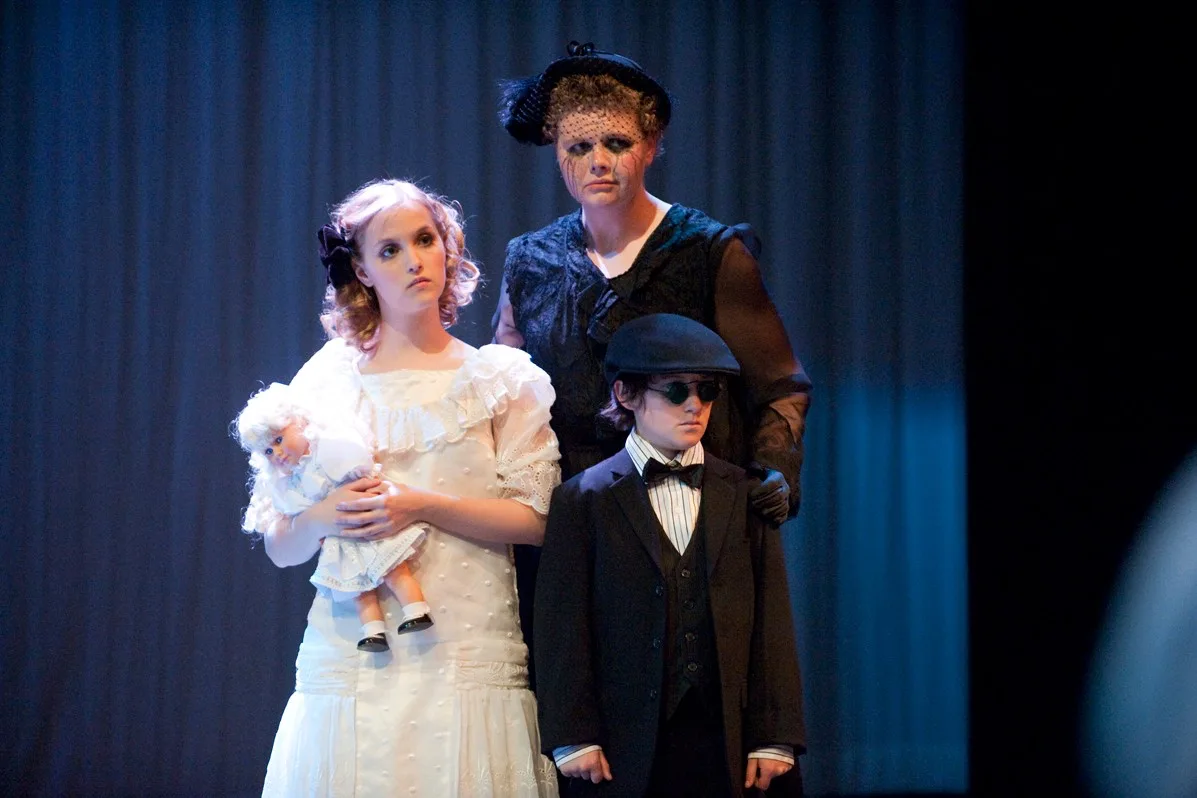
The children represent the most fragile part of this story. In almost every staging, the Little Girl's white dress stands out immediately because all the other characters wear black clothes. It could be referred to as a kind of purity that is already threatened by the world around her. Her tragic death in the fountain, as a sudden splash followed by the Boy's suicide, creates one of the most striking images in the entire play. These moments happen in great silence, so the audience confronts the scene primarily as a visual shock.
Visual Choices Across Different Productions
In theatre studies, mise-en-scène refers to the visual and spatial arrangement of a performance. It includes many elements: light, shadow, costume, bodies in movement, stage architecture, props, and most importantly the relationship between all these elements. In Six Characters in Search of an Author, the play keeps asking what it means "to appear." Here mise-en-scène is not secondary, it is the medium where meaning is produced.
Curtains and Entrances
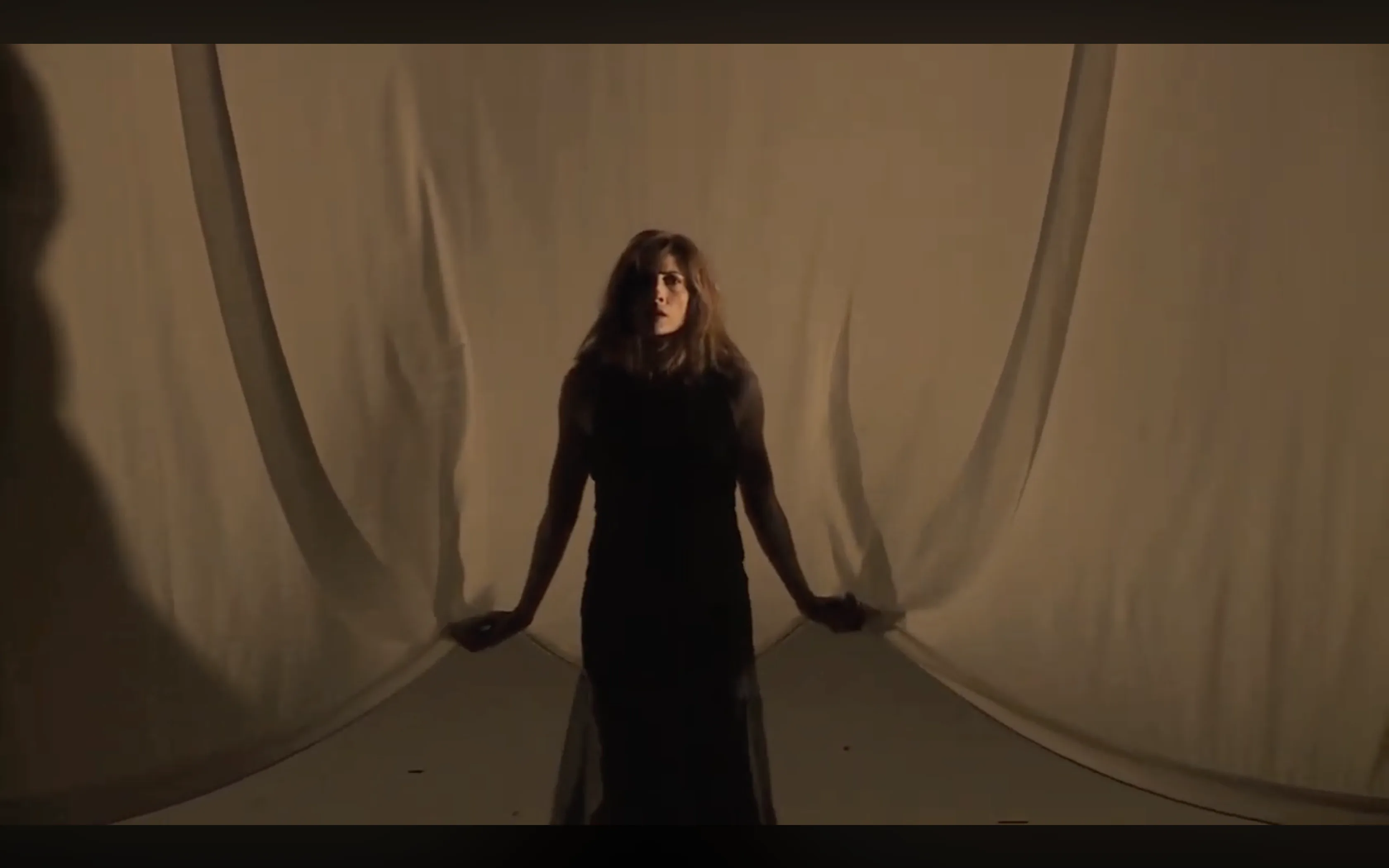
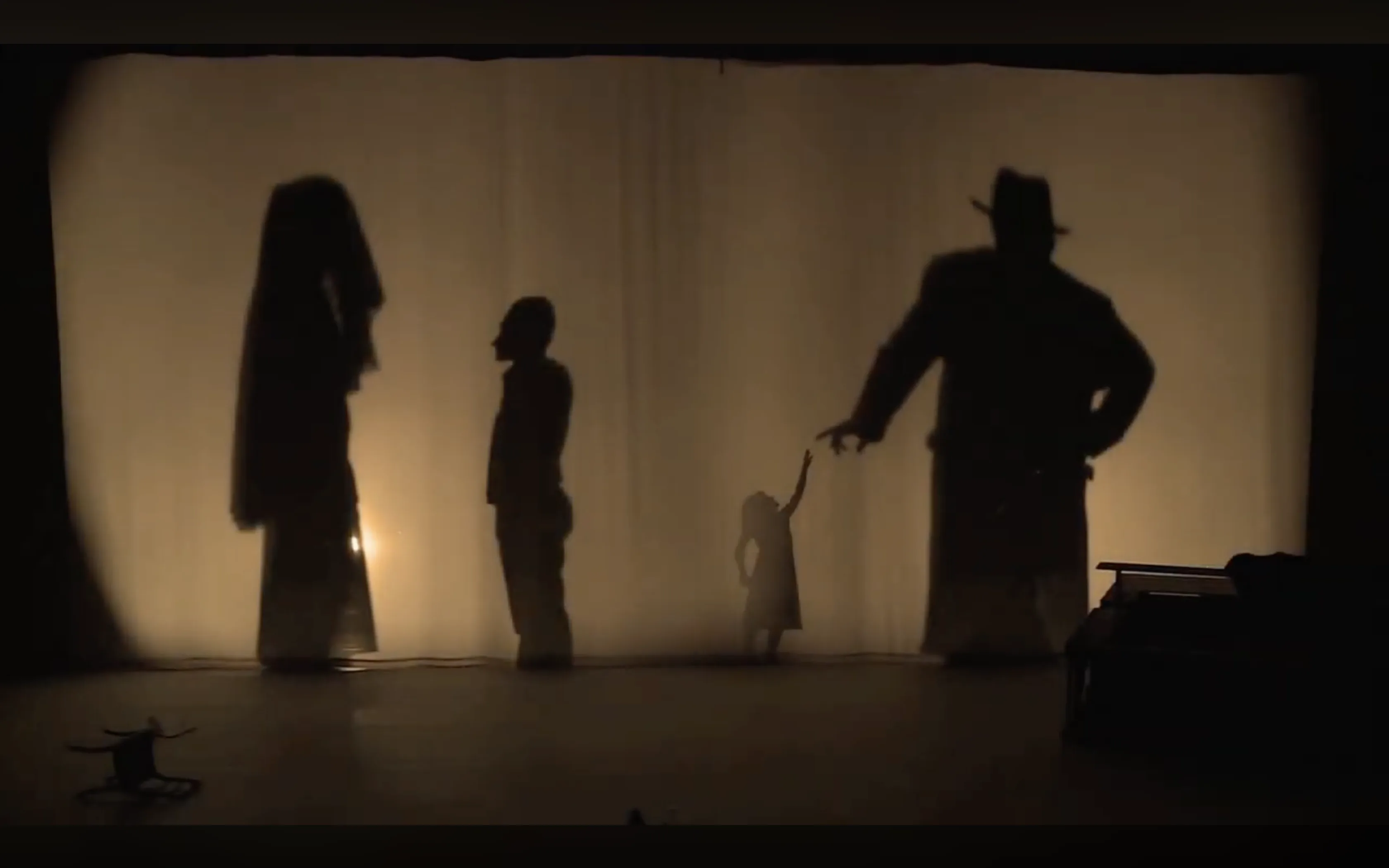
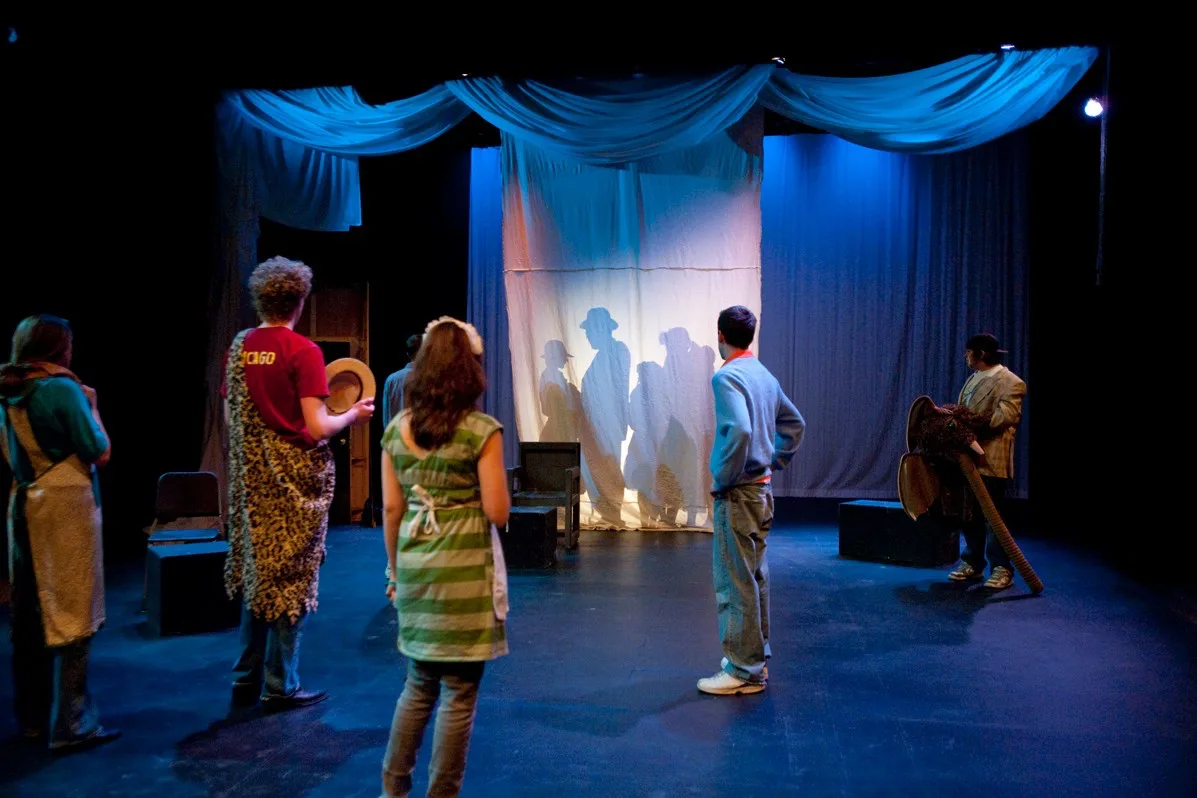
In some productions, directors place a curtain at the back of the stage, and this often becomes one of the most important visual elements. It can act like a border between two worlds. In the 2016 Elliott & Rodriguez-Elliott version and Emmanuel Demarcy-Mota's Paris staging, the shadows of the characters first appear from behind the curtain. This choice turns the curtain into something more than a stage device. It becomes a kind of threshold, a place where the text and drama becomes visual and appears into the visible world of rehearsal.
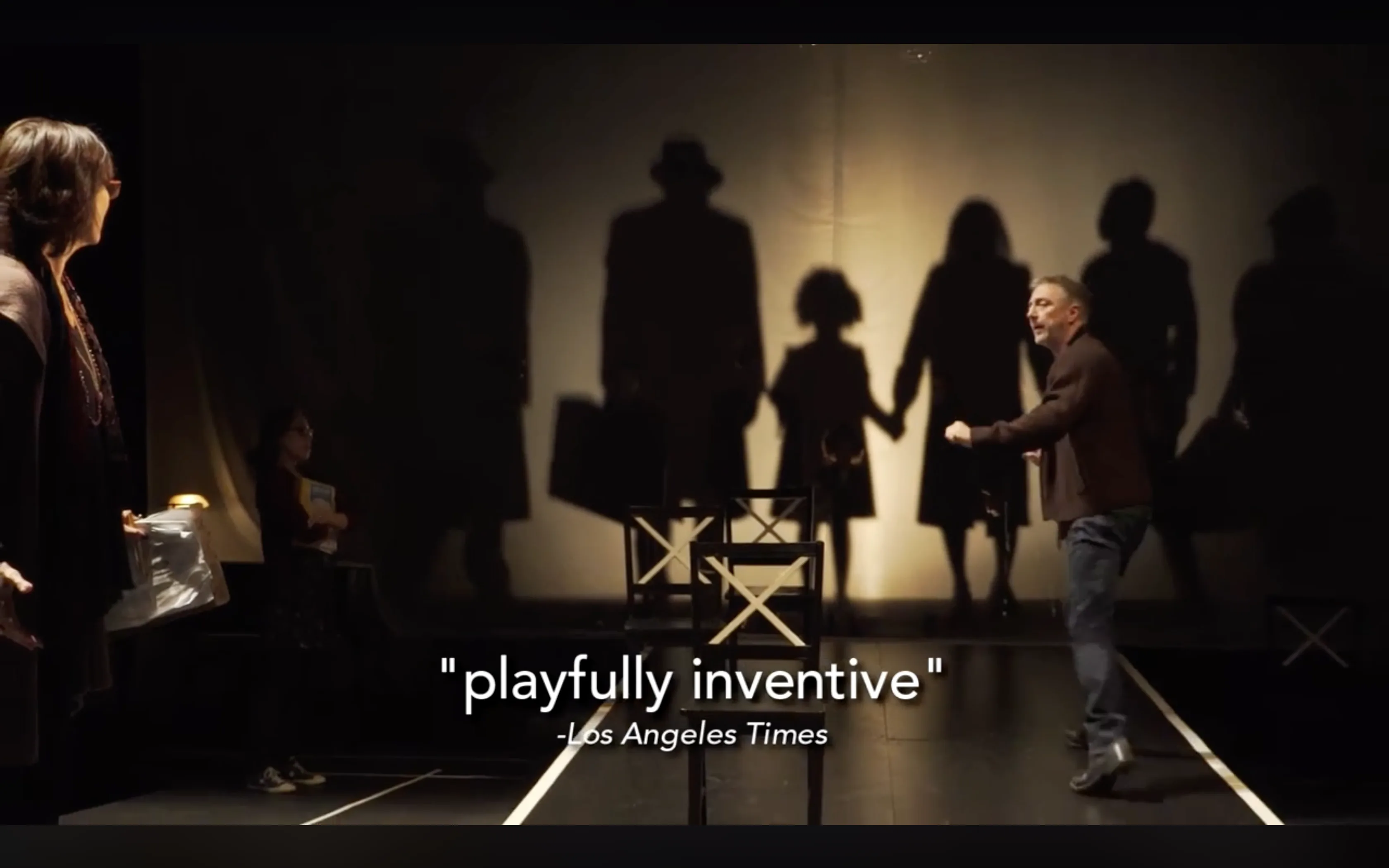
In Demarcy-Mota's long-running production (2001–2022), playing with shadows becomes one of the most interesting choices. The Step-Daughter's shadow appears on the curtain smaller, distorted, almost child-like, before she steps into full visibility. Her identity seems unstable before she even speaks. This visual hesitation shows Pirandello's idea that the Characters are not fully formed beings.
Shadows and Light
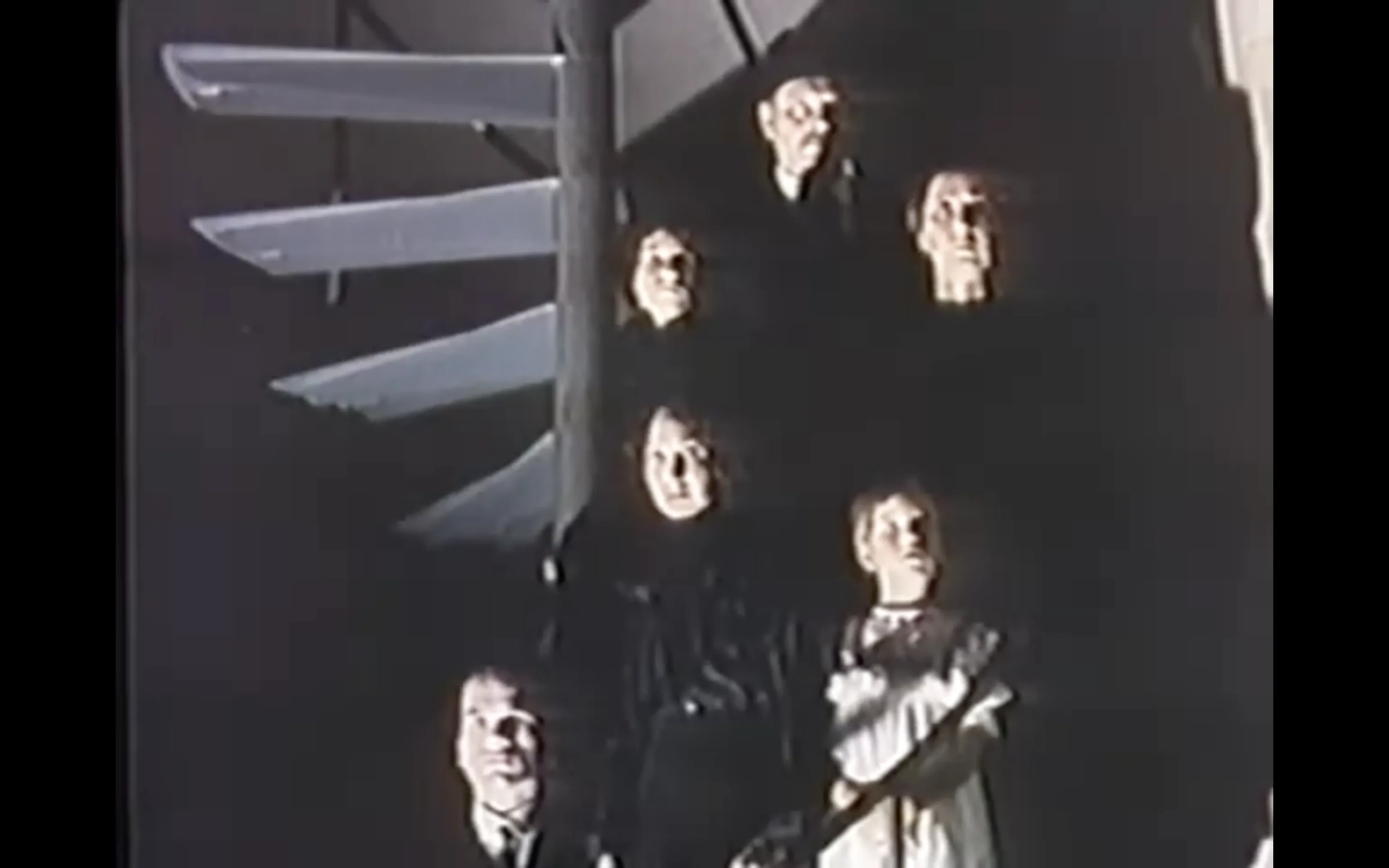
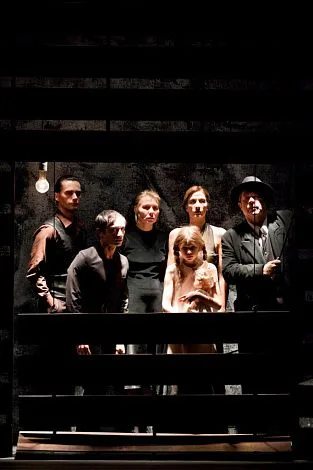
Light is one of the most important and vital elements of mise-en-scène. Even if the scene is empty, the light is the first element to be decided for the piece. In Kenneth Frankel's 1976 production, at the end of the play, the audience sees the Characters standing in the middle of stairs, which go above, but not sure where to, and they all together face toward the stage and the audience. All clothed in full black (except the Little Girl), with strong white makeup, with very harsh light so that only their faces and the stairs are lit. Their bodies seem incomplete, with parts swallowed by darkness.
Costumes, Makeup and Identity
Costumes play a major role in distinguishing Characters from Actors. In nearly all productions, the Step-Daughter appears in a provocative black outfit, while the Mother remains in heavy mourning clothes. These choices reflect the characters' emotional positions: the Step-Daughter wants to expose a painful scene and the Mother is frozen in her grief.
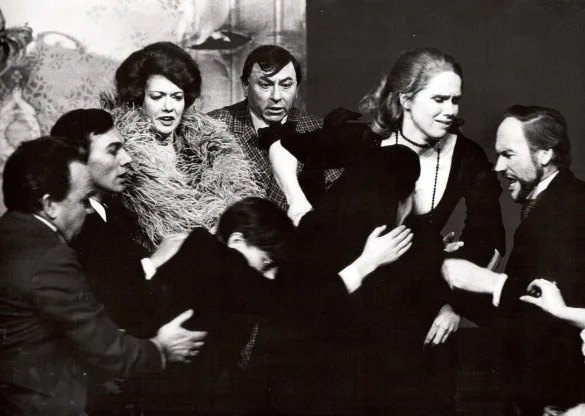
The white dress of the Little Girl appears in production after production. It marks her innocence and foreshadows her tragedy. In some productions, such as Bergman's 1967 version and Laura Jones's 2009 university production, the Boy is given sunglasses which hide his eyes and make him seem unreadable, as if he never fully grasped or saw reality.
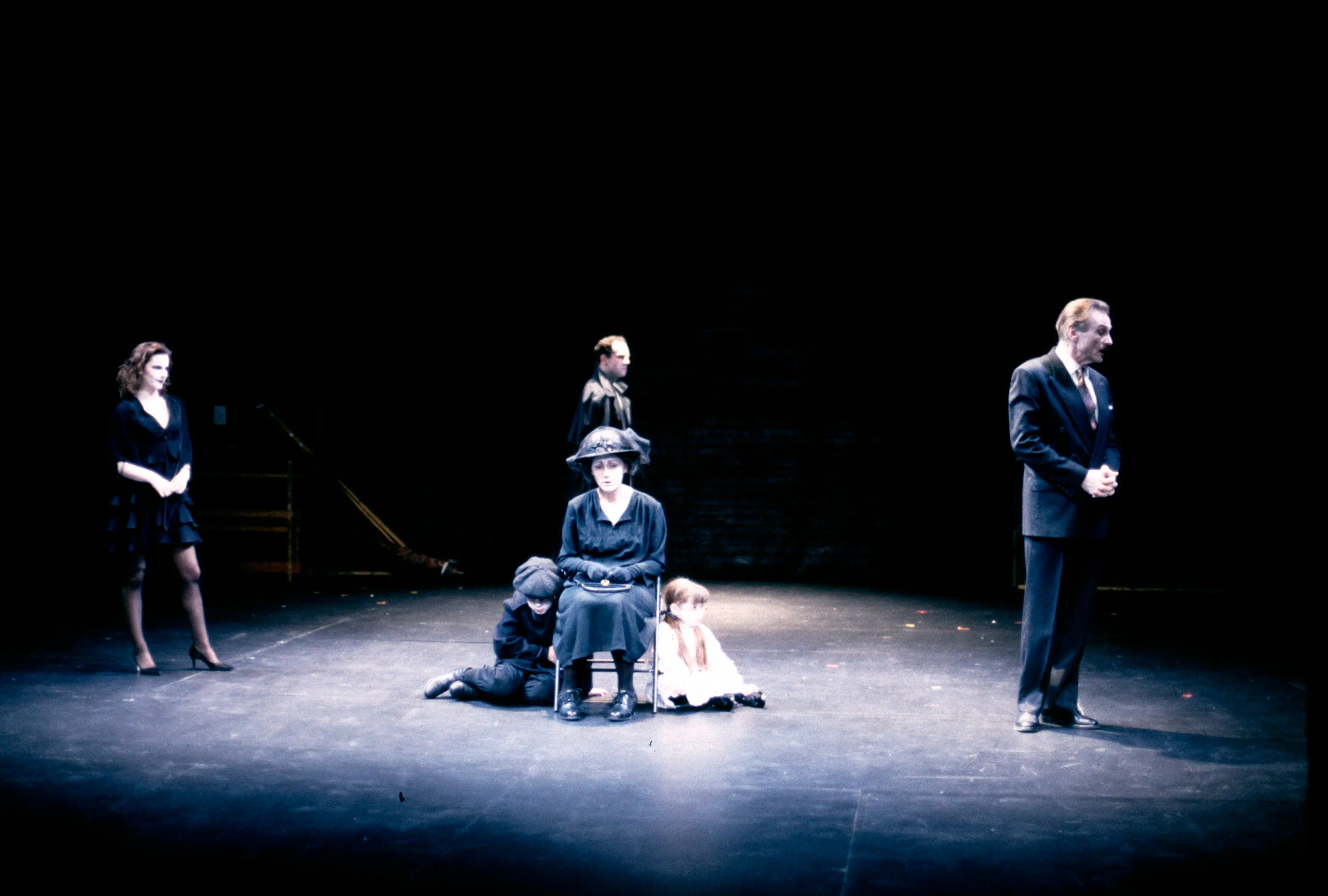
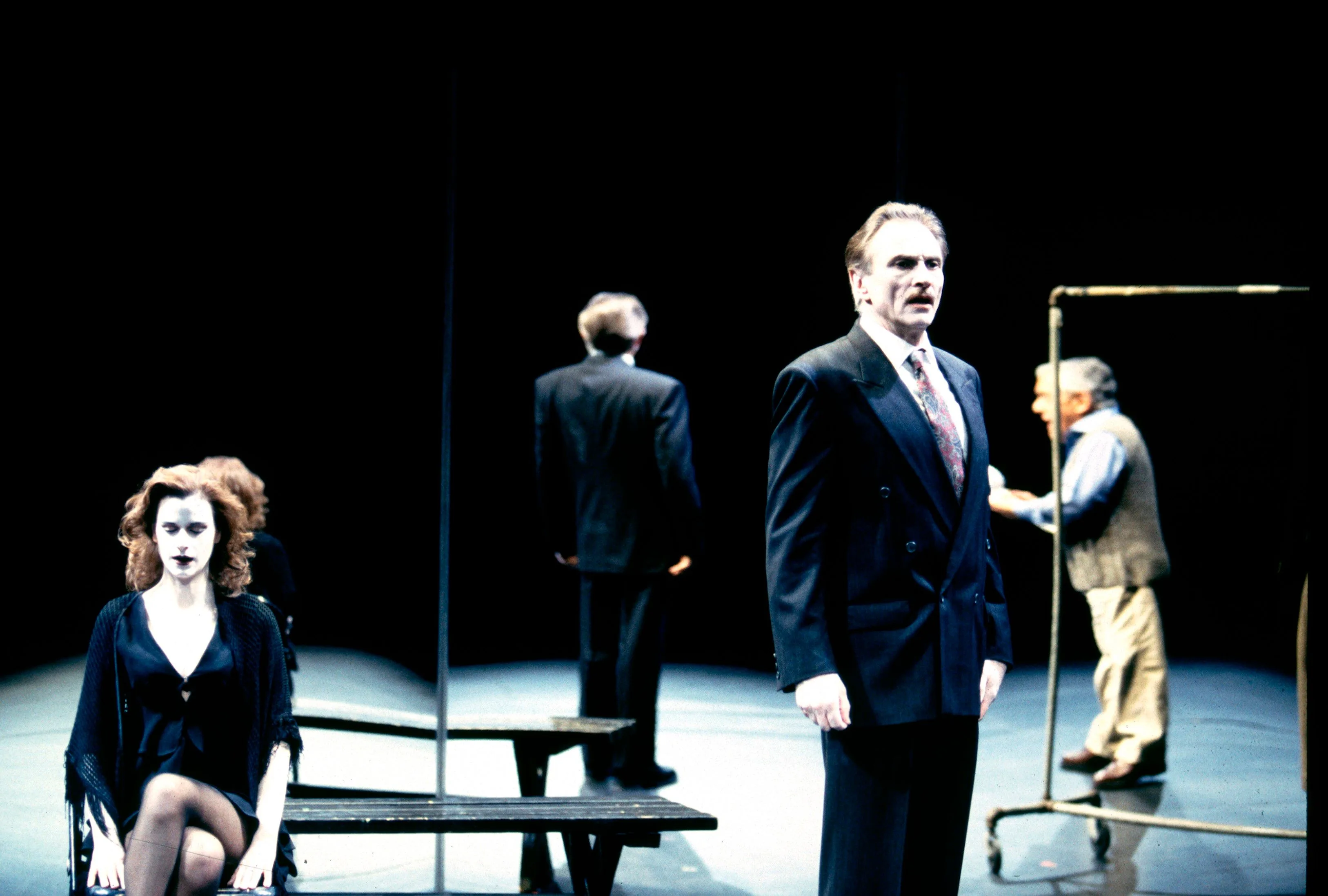
Brustein's 1996 staging uses pale makeup to give the Characters a mask-like appearance. Their faces resemble pantomime figures, emphasising their artificiality and their existence as images rather than psychological subjects.
Space and Perspective
Ingmar Bergman's 1953 and 1967 stagings offer another interesting approach. In his minimalistic productions he uses bare platforms and central lighting. Without scenery, the Characters' emotional tension becomes sharper; the empty space forces their drama into the open.
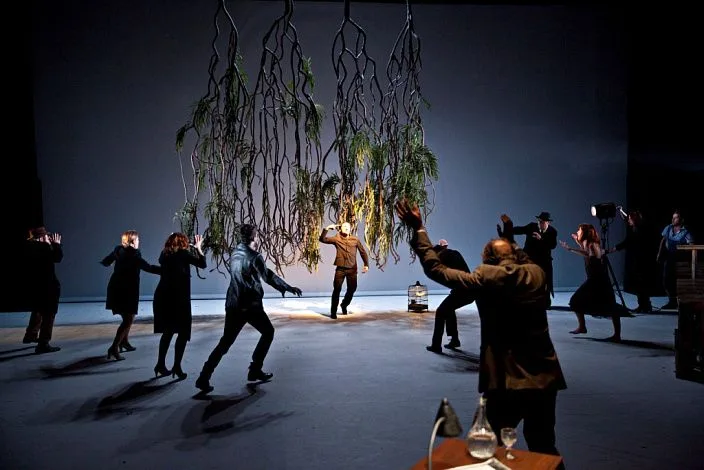
Demarcy-Mota introduces surreal elements, such as trees hanging upside down from the ceiling. This visually expresses the Characters' unstable identity and their search for a stable reality.
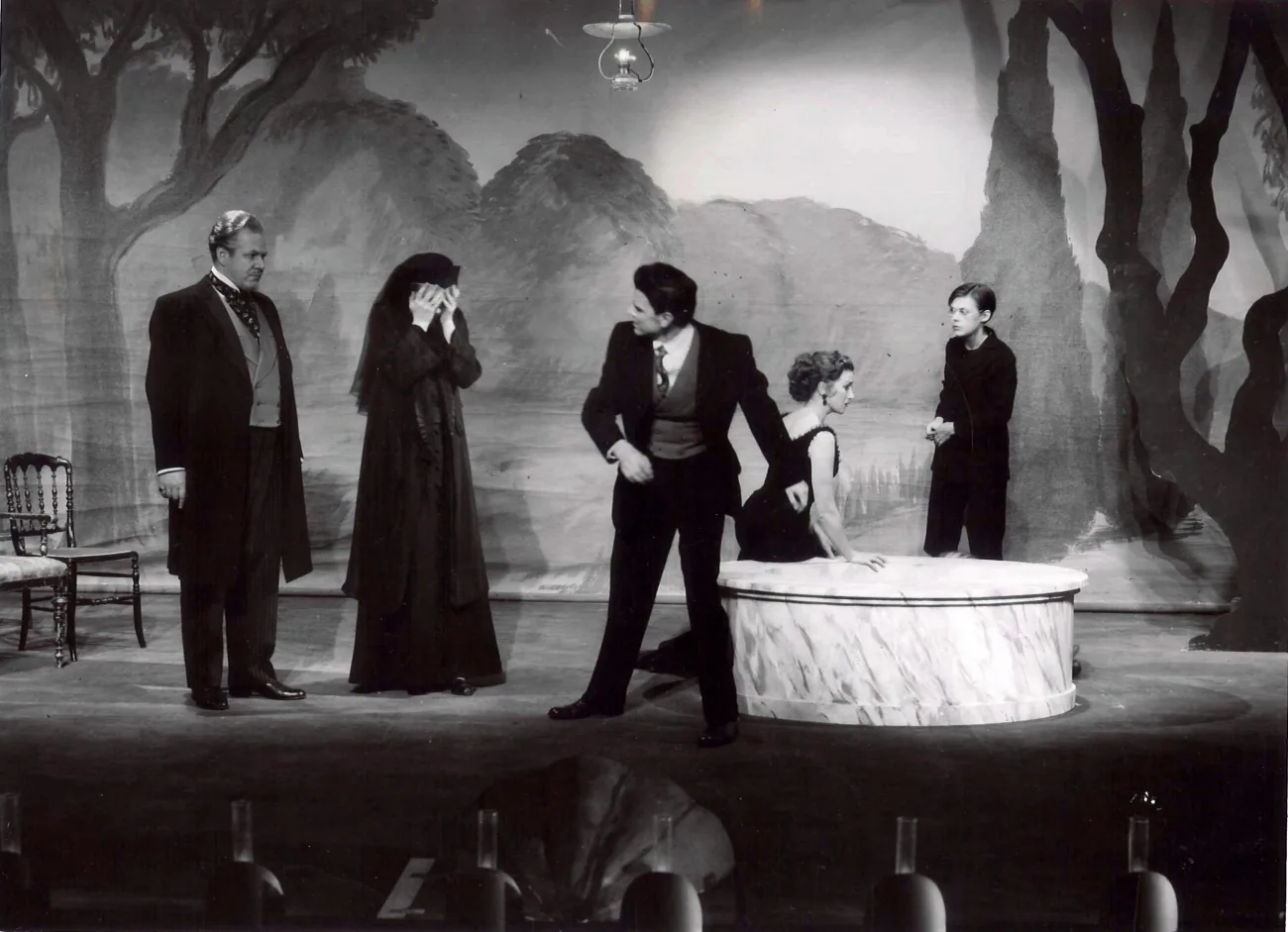
The white fountain used in many productions becomes a central visual object in the final scene. Its cold colour and simple shape draw attention to the Little Girl's tragic fall. The audience remembers the image more than the words.
What Staging Reveals About the Play
Recurring Visual Patterns
These repetitions do not seem accidental. They suggest that Six Characters already carries a strong visual structure inside it, and that staging simply brings this structure to the surface. The Characters' crisis is not psychological but visual. Their problem is that they cannot fully take form. Illiano argues that what makes this play special is that the audience gets to watch the whole creative process happening live in front of them, instead of just seeing a finished product.
Theatre as Visual Completion
In theatre, the most vital element for the director is mise-en-scène, which does not simply decorate the play or illustrate its ideas. It completes what the text begins. The stage becomes the Characters' true home, where appearance creates reality. By using light, costumes, positioning, and space, the audience sees the Characters' unstable nature, their constant attempt to hold onto a form that keeps slipping away.
Conclusion
This essay has tried to show that Pirandello's Six Characters in Search of an Author is not only a text to be read but also a visual experience to be seen. The Characters did not come to Pirandello as ideas first. They appeared to him as images—faces, gestures, clothes—and he followed them. In other words, the image came before the words.
Across these productions, from the 1940s to today, we can see that directors keep coming back to the same images: curtains used as thresholds, shadows that blur the Characters' forms, black mourning clothes next to one white dress, the fountain at the end. These patterns are not accidents. They seem to come naturally from Pirandello's idea of the character as an incomplete being who can only exist when visible.
In this sense, the play fits within the broader "pictorial turn" that scholars like W.J.T. Mitchell have described, a shift in which images are no longer secondary to words but become central to how meaning is made. The relationship between literature and visual culture in Six Characters is not just about adding images to a text; the visual dimension is already inside the text, waiting to be brought to life on stage. Each director who stages this play continues the work that Pirandello started when these figures first appeared to him. For the Six Characters, to exist is, in the end, to appear.
Works Cited
- Pirandello, Luigi. Six Characters in Search of an Author. Translated by Edward Storer. New York: E. P. Dutton, 1922.
- Bonanni, Luisa. "Pirandello e il pensiero visuale." Lebenswelt 22 (2023): 134–148.
- Illiano, Antonio. "Pirandello's Six Characters in Search of an Author: A Comedy in the Making." Italica 44, no. 1 (March 1967): 1–12.
- Needler, Howard I. "On the Art of Pirandello: Theory and Praxis." Texas Studies in Literature and Language 15, no. 4 (Winter 1974): 727–760.